Clean, dry air is critical to the success and efficiency of pneumatic systems, but contamination and condensation are unavoidable when generating compressed air. One source of contaminants is the air being drawn into the compressor. Dirty, wet air is still dirty and wet after compression. In fact, compression generates heat and increases the air’s temperature and capacity to retain moisture. Without filtration and drying, the air will contain all the contaminants of the ambient environment.
Types of contamination include atmospheric dirt; water vapor, condensed water, and water aerosols; rust and pipescale; micro-organisms; liquid oil and oil aerosols; and oil vapor. All these contaminants form an unwanted and often acidic condensate, which rapidly wears tools and machines. Further, contaminants clog valves and orifices and cause air leaks, raising maintenance and operating costs. And condensed water and water aerosols corrode storage and distribution systems, damaging both production equipment and the end product.
Water hazard
Compressed air typically contains water as both liquid and vapor, and the amount is staggering. A small 100-cfm compressor and refrigeration-dryer combination, operating for 4000 hours in typical climatic conditions produces approximately 2200 gallons of liquid condensate per year. With larger compressors or in warmer, more humid climates, the volume of condensate increases significantly. Water, in any form, must be removed for the system to run correctly and efficiently. That is why dryers are imperative to generate clean, dry air.
Drying the air can range from trapping condensed water and preventing additional condensation of water vapor to removing virtually all the water present. The more water removed, the higher the cost. However, if too much water remains in the compressed-air supply, the price is paid in downtime, higher maintenance, corrosion, damaged product, and premature equipment failure.
Specifying air purity Fortunately, a range of drying options can help eliminate these costs. Some applications need only a single component to reach the requisite purity. Most, however, require a multi-step circuit that includes several progressively aggressive purifying methods. Among the options available:
• Aftercoolers reduce the temperature and water content of compressed air.
• Bulk liquid separators remove liquid condensed in the distribution system.
• Particulate filters remove solid-particle contaminants down to 5 μm and separate bulk liquids from the air stream.
• Coalescing filters remove liquid aerosols and particles (not vapors) down to 0.01 μm in size.
• Refrigeration dryers generate dew points of 37° to 50°F.
• Desiccant dryers produce dew points of -40° to -100°F.
• Membrane dryers have variable drying capabilities from -40° to +35°F dew points, depending on flow. In most plants, one compressed air system supplies many applications. But actual point-of-use air quality requirements vary depending on the individual workstation or machine. As a rule of thumb, compressed air should be treated prior to entering the distribution system and at each point-of-use. This approach provides the most economical system purification by removing residual contamination in the distribution system while ensuring that critical areas receive air treated to the highest purity – to protect valuable equipment and prevent expensive downtime.
Experts recommend a careful approach to system design, commissioning, and operation to meet the stringent air-quality levels required for today’s modern production facilities. The International Standards Organization (ISO) sets the standard for the quality of compressed air, detailed in ISO 8573. Point-of-use filtration and air dryers help companies meet these goals.
Dryer types
While centralized dryers play a role in compressed air systems, economical and compact refrigeration, desiccant, and membrane dryers are often overlooked – even though they can be installed precisely where needed. Firms that avoid point-of-use dryers to save money are advised to evaluate new dry-air products. These often offer affordable, flexible designs with significant benefits that increase financial value. Here’s a look at the major types.
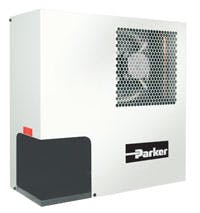
Refrigeration dryers – As the name implies, refrigeration dryers work by cooling the air to low temperatures and condensing much of the water vapor for expulsion through a drain. Ideal for general-purpose applications, this type of dryer does not produce dew points below freezing. Typical pressure dew points are 38°, 45°, or 50°F. Refrigeration dryers remove the heat from the inlet air and use it to reheat air at the outlet. Dried air returns to the air line at ambient temperatures. This process eliminates “sweating” cold pipes when working in humid conditions. Self-contained refrigerant dryers use fans to cool the refrigerant condenser and automatic controls to manage the heat-exchange requirements. These systems keep the delivered air at a constant humidity and dew point. They require coalescing filters upstream to prevent oil/liquid water from entering the dryer. Oil coating the cooling surfaces decreases efficiency while water reduces system capacity.
Refrigeration dryers are not suitable where piping experiences ambient temperatures lower than the dryer dew point. For example, it is not appropriate to use a 37°F dryer in an installation with outdoor piping and ambient temperatures below freezing.
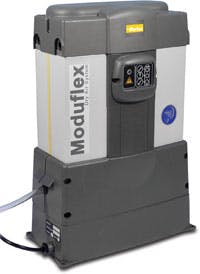
– Adsorption dryers are for applications that require extremely dry air. They are generally installed downstream of an aftercooler and/or a refrigeration dryer. Inline adsorption dryers rely on desiccant contained in a vessel. Compressed air passes through the vessel and across the desiccant bed, which adsorbs water vapor. Very dry air exits. Dew points vary according to the application, but typical levels are -40°F and dryers with special options can reach -100°F.
Heatless regenerative desiccant dryers also use the dry air to remove water from the desiccant material. Air is redirected to one of two desiccant beds at regular intervals, regenerating the inactive bed. Dry air passes over the inactive desiccant bed and water evaporates. This moisture laden air subsequently vents to atmosphere. The major advantage to heatless desiccant dryers is reduced dependence on expensive utilities, particularly steam, electricity, or other heat sources. The dryers require relatively little electricity to operate.
Depending on the size, users can install adsorption dryers near the point-of-use to deliver instrument-quality air for critical applications. It is important to note that the actual temperature of air exiting an adsorption dryer is not the same as its dew point. This is beneficial since a pressure dew point of -15°F or lower not only prevents corrosion, but also inhibits the growth of microorganisms within the compressed air system.
Protect desiccant dryers from liquid water by installing a coalescing filter upstream. Oil or water entering the dryer adversely affects dryer performance and can destroy the desiccant material. It is also good practice to install a filter downstream from the dryer to prevent desiccant from carrying to downstream equipment or processes.
Membrane air dryers – Membrane materials that are selectively permeable to water vapor are an excellent medium for producing dry air from standard compressed air. Membranes consist of bundles of hollow fibers. As the compressed air passes through the center of these fibers, water vapor passes through the walls. The units redirect a small portion of the dry air (purge flow) along the outside of each hollow fiber carrying away the moisture- laden air, which then exhausts to atmosphere. The remainder of the dry air is piped to the application.
Membrane dryers can be conveniently located near the point-of-use and supply clean dry compressed air with dew points from -40° to +35°F depending on flow. As with refrigeration and desiccant dryers, coalescing filters should be installed upstream to protect the membrane from being saturated by water or coated by oil. Saturation or coating can seriously inhibit drying capability.
Complete dry-air systems Install point-of-use dryers based on cost, fit, and function. But the time and expense saved in maintenance, reliable system performance, and higher air quality are all reasons to consider installing a dryer, regardless of the product manufactured or aircompression system. When creating a complete, clean and dry air system, keep the following in mind:
1. Dryness is relative. For general plant air, the compressed air’s dew point should be about 20°F lower than the lowest ambient temperature to avoid freezing. 2. Inlet temperature is a key factor. A 20°F temperature drop condenses 50% of the humidity out of the air. 3. Do not overspecify. Drying the entire compressed air supply in a factory to -40°F dew points is wasteful. It is more sensible to subdivide the compressed air supply by application, treating each end-use point as needed to provide appropriately dry air.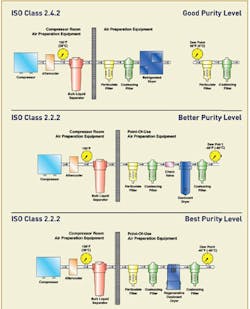
For more information on pointof- use dryers, including catalogs and specs, visit www.parker.com/pneu/dryers or contact the author at [email protected].