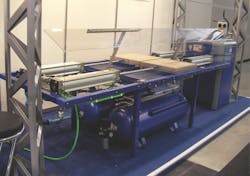
When Chris Bosua, of Australia, was trying to make a manufacturing machine work with an air compressor that was too small for the job, he realized that the real problem was waste — the energy used to create the compressed air was wasted in the exhaust air from the pneumatic tool.
To reduce this waste, Bosua thought it would be helpful to design a closed-loop system that would send air right back to the compressor, just as a hydraulic tool returns spent fluid back to tank. Out of this idea came the Exhausted Air Recycling System (EARS), distributed in the U. S. by Michigan Pneumatic Tool Inc., Romulus, Mich. The system converts a conventional compressor into one capable of nearly twice its original capacity, according to Bousa.
Multiple Benefits Realized
However, EARS doesn't just increasing capacity. Bosua soon discovered several other benefits with the new system, including a dramatic reduction in noise. The pneumatic drills used in his machine generated noise of 89 dBA prior to the implementation of EARS. After the conversion, noise from the drills dropped to just 67 dBA — roughly the difference between a gas-powered lawn mower and a sewing machine.
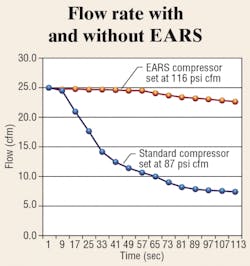
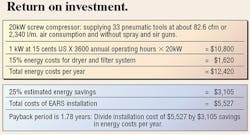
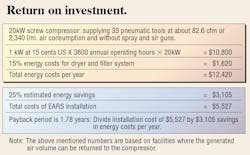
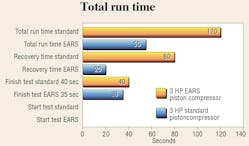
Other benefits were realized as testing continued. Not only did the system generate 80% more air volume, Figure 2, but the return of pressurized air to the inlet of the compressor cut energy consumption by more than 40%. The reduced energy consumption contributed to a short return on investment, Figures 3 and 4. In addition, the closed-loop air was cooler and up to 70% dryer because the compressor no longer needed to pull in ambient air and cool it. This extended the life of tools, hoses, and the compressor.
Finally, the air tools no longer emitted oil vapor and other harmful exhaust into the atmosphere. Because the tool exhaust was returning through a hose to the compressor, dust and debris was no longer blown about from the exhaust of the tools.
Retrofit Kits for All
Bosua realized he needed to develop retrofit kits for common air tools and air compressors.
According to Cliff Kniesly, of Michigan Pneumatic Tool, “The system is designed to allow the retrofit of existing equipment, whether that be existing air compressors, actuators, multiple tools, or entire machines.”
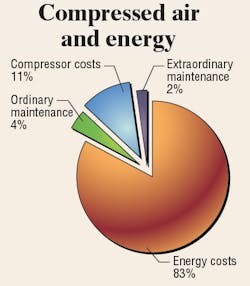
Kniesly added that the practicality of the system depends on the condition of existing equipment and if the facility has excessive compressor capacity. “As plants lean down, they may still be using a 200-hp compressor, even though EARS may be fully supported by a machine half that size or less. Because more than 80% of compressed air over five years is for energy, often a smaller, more efficient compressor has a faster return on investment.” Figure 5 highlights the total real costs of compressed air for industrial use.
Full Constant Power at Low Energy Consumption
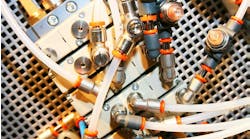
A manifold is a key piece of the EARS because it allows the exhausted air from the air tool to flow into the compressor, forming a closed-loop system. The coupling on the end of the air tool ensures the exhausted air is captured and sent to the manifold. The closed loop allows the compressor to re-compress the exhausted air and send it back to the air tool.
Because it has already been compressed, the air re-circulated to the compressor is at a higher pressure than atmospheric pressure. The compressor, therefore, does not need to work as hard to maintain the pressure required. Within this closed loop system, the pressure and the volumetric flow remain almost constant. This helps shorten the reloading time that the compressor needs to return to working pressure.
The EARS compressor works faster to maintain the compressed air volume required than a conventional compressor. That reduces the power consumption of the compressor, thereby reducing costs.
Adaptive Tools Simplify the Job
EARS air tools are equipped with an integrated exhaust air adaptor that feeds the compressed air back to the compressor.
Many existing conventional air tools can be retrofitted with special adaptors. The range of compressed air adaptors is continually updated in order to cover a varied range of compressed air tool manufacturers. This minimizes the requirement to invest in new tools when retrofitting with EARS.
Making the Connection
EARS uses polyethylene (PE) compressed air piping. It is easy to install and is flexible for future changes or modifications. The PE piping also provides maximum flow to the tools and is available in diameters from 25 to 110 mm.
Polyurethane dual hose sets are preassembled in both straight and coiled versions, in both metric and conventional lengths. Coiled versions come in lengths from 13 to 33 ft, and straight models are available in lengths from 10 to 39 ft.
In addition, plastic couplings and a complete range of PE-100-SDR9 tubing are completely air-tight and UV stable. An installation wrench allows coupling nuts to be tightened or quickly released. The twin coupling developed specifically for the EARS application flows up to 64 cfm.
High Performance, Low Cost
Because an EARS-fitted compressor delivers more air volume, a conventional compressor with a larger motor would be needed to match it. Larger motors and compressors cost more and require more energy to operate. By retrofitting an existing compressor with EARS, reportedly users can save up to 40% in energy costs alone. An additional benefit is that tools and equipment may last longer with EARS.
For more information, call (313) 933.5890, or visit www.earsnorthamerica.com.